When digital economy and Big Data empower our lives and increase inequalities of the UK’s education system, student protests turn out to be powerful very quickly. The article of James Meadway we publish explains why this method of algorithmic working was bound to fail and our hypothesis is that “Fuck the algorithm” could become a worldwide slogan!
Blog editorial team
Protesting students and a national outcry have forced a U-turn over A-level marking in Scotland, and subsequently Wales, England and Northern Ireland in quick succession, despite the UK government’s public belligerence at the prospect of revising students’ algorithmically-moderated grades. The modelling that had been applied will now be scrapped in favour of teachers’ assessments for both A-level and GSCE students. It’s a major victory for the thousands of students who have protested.
The anger has been completely justified. The model that had been applied appears to have been designed to produce results that, on the headline measures, looked ‘fair’ (in that the averages could look about right) whilst forgetting that the distribution of overall marks was itself the product of many thousands of individual results. Throw in the fact that searching for an average based on historic performance inevitably tends to favour those who have historically done well – which, in the British case, has privileged the private sector – and the stage was set for a spectacular government failure. It’s now clear that education secretary Gavin Williamson, “promoted beyond his competence”, needs to go.
Beyond the specific government failures here, however, such as the lack of oversight and review – including attempting to silence competent professionals – the fiasco and the protests indicate a trend for the future.
Since the Covid-19 outbreak erupted, fundamentally (and permanently) disrupting how we live and work, the presence of data and statistical modelling in all our lives has accelerated markedly. From working-from-home on one side to increased biosecurity surveillance on the other (itself ranging from contact-tracing apps to temperature monitoring to “pandemic drones”) – the weight of data in our everyday lives has dramatically increased.
We’ve all become very familiar with this ghostly digital presence in the decade since the Great Financial Crisis, as (mainly US) Big Data companies have exercised their extraordinary capacities to gather, store and analyse our data, resulting in immense gains for them and an increasingly data-saturated world for the rest of us.
One way or another, the fact of algorithmic prediction has become an accepted part of how we live, most obviously online in the form of recommendation algorithms. One set of consequences – surveillance capitalism’s insatiable greed for the data we produce – is becoming better-known. The hunger is driven by the raw economics of the digital economy: each dataset that can be obtained is worth more if it can be compared with another dataset, so the value of a data company is always maximised by grabbing as much data as it can.
Usually, we don’t notice the algorithms that are used to do this. The entire purpose of those used for behavioural analysis is to forecast, as far as possible, the actions of individuals on the basis of past data. Increasingly, they are also intended to shape the behaviour of individuals in particular ways – to guide us to specific YouTube videos or Facebook advertisers or whatever. They might also be used to shape our political beliefs and preferences, as we have seen.
The critical issue with exam results is that this method of algorithmic working was bound to fail. On average, the algorithm may be more or less correct, but the ‘average student’ does not really exist – it’s a statistical fiction, generated from data which describes many thousands of individuals, none of whom are the ‘average’. Specifically for exams, moreover, there are individual people who we expect to be judged against the criteria of both their own performance and some objective standard – not against the performance of the average, either today or historically. In situations like marking exams we have specific expectations of individual autonomy and the recognition of individual merit which statistical techniques tend to override.
So what we can tolerate for, say, targeted advertising, we find intolerable for exams, which have precisely the worst possible combination – from the point of view of algorithmic processing – of four factors: being applied en masse, in public, where specific individualised results are required, and where the results for an individual are supposed to say something about their merit or worth in a particular dimension with meaningful consequences.
(Obviously, exam results aren’t the only dimension we might judge people on, and mercifully, we tend not to filter any of the others through any sort of marking scheme – although, inevitably, one UK government advisor is at least interested in China-style social credit systems.)
Environmental instability
The combination of the first three factors – mass processing, public display, individualised results – makes the case for protests clear, and the last – that the results should bear some relationship to true merit – makes it desirable. Most algorithmic processing will have only one or two of these four factors: the fact that Facebook is choosing to display some adverts to you on the basis of the statistical assumptions it makes about you is certainly individualised, but it is also not something intended for wider social comparison. Most algorithmic processing will not result in protests; as it becomes ubiquitous, we may be largely unaware it is even happening, and we may not care too much.
But one thing we have learned from this pandemic is that environmental instability – of which Covid-19 is a profound example – brings with it a deeper and deeper dependency on data. The semblance of accounting and control that Big Data provides, built-in to the business models of our data economy and increasingly factored into the functioning of government, becomes more – not less – appealing in unstable conditions.
The social structures we currently use to manage our glut of digital information – principally the giant tech companies – have every incentive to maximise their reach across social life, given the blunt economics of data: more data means more value, so grab more data. And governments, confronted by conditions over which they have increasingly little control or sway, facing populations whose cynicism about government itself remains at historically high levels, have every incentive to try to utilise mass data techniques themselves. The (relatively unsophisticated) A-level results modelling was introduced, for instance, precisely because the pandemic had resulted in the cancellation of the actual exams: it was an attempt to cope with contingency on the basis of a forecasting model.
Put these two elements together – the raw economics of Big Data that drive its expansion, and the desire of governments to try to assert some control in situations of instability – and the likelihood is that algorithmic management becomes more common as part of how government operates, not less. And of course to the extent that government data is immensely valuable, like the treasure trove of NHS data, Big Data will be more than happy to assist governments in making use of it. Michael Gove’s recent speech on the future of government, for example, explicitly highlighted the need to “open up” government data in this fashion. The direction of travel is clear, and – under current circumstances – instability will accelerate us along it.
Politicisation
But as the techniques of modelling and forecasting become a more significant part of government, they become politicised. Alongside our belief in the autonomy of individuals and the belief that they ought to be assessed according to their own merits is a belief that government should be fair and transparent.
We have built entire systems of governance and rule around roughly those ideas: the legal system depends on this principle – that the assessments it produces are fair because they are delivered on the basis of evidence that is seen, and made on the basis of the individual standing trial or settling a dispute. We elect governments in a process that hides our personal choice, but which is intended to provide scrutiny and transparency of whatever government then emerges. Both systems may fail, but they fail relative to that approximate (and widely-held) ideal.
Statistical modelling, particularly as it becomes more sophisticated, does not work like this.
It is hard for us to understand even a relatively simple model, such as that used for the A-level results. (The Royal Statistical Society’s letter to the Office for Statistics Regulation is a good guide to the problems, however.) By the time very large datasets are being used, particularly in machine learning, the results that are produced may become literally indecipherable – they are, in the jargon, not ‘interpretable’. It is not possible to see why a large statistical model produces a result, and nor is it possible for the computer – unlike a judge or a politician, say – to explain why it reached a particular conclusion. Increasingly sophisticated machine learning means that algorithms are getting better at accounting for individual nuance. But if what they are going on is past behaviour, they still start to hem in future choices and can produce radically unfair outcomes.
Again, we might tolerate this in much of our online life. The fact a particular shop is being advertised to you in particular probably doesn’t matter too much. But if the decision-making process starts to intrude on questions of underlying value, or where the outcome has profound consequences on your life, it matters a great deal. And if it is the government making those decisions, the clash between our expectations of fairness and the actual results produced by government may become profound. This is the moment of politicisation: once a procedure is moved from the realm of the mundane, or from where a market can be blamed for an outcome, and into the realm of what we think of as government, it is open to political protest.
(I’m reminded somewhat of the politicisation of the labour market that took place in the West during the post-war boom. Once governments broke with liberal capitalism and accepted some responsibility for the management of labour, it politicised the question of how labour was managed. The early years of neoliberalism in the West were, in part, an attempt to break out of this problem by having states refuse to accept this responsibility. For the regimes in the East, the problem was chronic: the attempt by government to set the conditions in every market, including labour, meant everything was always the government’s problem. Every strike suddenly took on a political character.)
We have already seen multiplying protests during the pandemic, from Black Lives Matter to an uptick in strikes. We have also seen legal objections being raised, successfully, to the use of automated facial recognition, and we should expect further legal challenges to the encroachment of algorithmic methods in future. But what the A-level protests point towards are the opening rounds of a new form of protest, against a new style of government: one that appeals directly to our faith in fair, transparent, and human-centred processes, on one side, and against the opacity and unfairness of statistically-determined outcomes on the other.
« Nous, Désert’heureuses, refusons de continuer à robotiser, mécaniser, optimiser, informatiser, accélérer, déshumaniser le monde... ».
Nous publions ci-dessous le manifeste de ce tout nouveau collectif de jeunes diplômé.es des plus grandes écoles d'ingénieur.es françaises. Il s’agit non seulement de réfléchir à de nouveaux modes de production pour sortir du capitalisme technocratique et productiviste mais aussi d’agir et de faire exploser les remparts que le système de domination des grandes écoles reproduit depuis plus de deux siècles. Une approche militante radicale dont l’IDST ne peut que se réjouir et qui, espérons-le, sera largement suivie.
Centro Indígena de Capacitación Integral (CIDECI-UniTierra Chiapas)
La idea generalizada que tenemos de la Universidad es la de un lugar en el que estudiar durante un tiempo y acabar consiguiendo un título que certifica el supuesto aprendizaje obtenido. La continua mercantilización de la enseñanza promovida por el sistema capitalista también nos lleva a pensar en la Universidad como un lugar excesivamente caro, al que solo algunos tienen la posibilidad de ingresar y en el que, finalmente, recibes un título que ya no te sirve para trabajar (y que, a veces, tampoco refleja los conocimientos adquiridos). Si pensamos en alguna facultad concreta acabamos pensando en un edificio grande, de hormigón gris, quizás adornado con un césped y formado por las últimas tecnologías (en lo que sea). A veces también pensamos en facultades que se caen a pedazos y aulas masificadas. Esto es exactamente lo que no quería el Doctor Raymundo Sánchez Barraza. El Centro Indígena de Capacitación Integral – Universidad de la Tierra (CIDECI-UniTierra) se plantea como todo lo contrario a esa concepción capitalista del aprendizaje que tan asumida tenemos. Por eso es imposible acercarse al proyecto (hoy realidad tangible) sin que se derrumben los esquemas aprehendidos. No se concibe entender el Sistema Indígena Intercultural de Aprendizaje sin la destrucción de lo establecido. Este proyecto comienza a andar en 1983, sin embargo, no es hasta 1989 que se define como autónomo. En ese año es auspiciado por el obispo de San Cristóbal de las Casas, Samuel Ruiz, conocido por su labor indigenista y de apoyo a los pueblos originarios del Estado de Chiapas. Y por ser obispo de la ciudad durante más de 40 años (hasta que el poder consiguió alejarlo de allí para que dejara de provocar fallas en el sistema). Coordinado en todo momento por Raymundo Sánchez Barraza, quién también regala su vida a la causa indigenista. En 1994 los ideales zapatistas se entroncan con los del CIDECI y no se entiende su filosofía sin ellos. Según su coordinador (quien suelta una carcajada al momento de dirigirnos a él como Rector) la denominación de Universidad es un acto de rebeldía, una respuesta a las burlas del sistema al referirse a ellos y al no considerar la capacitación que allí se recibe como un aprendizaje real. Y es que UniTierra ni es oficial ni busca el reconocimiento oficial, sino el de los pueblos y las comunidades indígenas. Indudablemente, ese ya lo tiene. Entonces “¿por qué no podemos tener el prestigio de las universidades?”, se pregunta Raymundo Sánchez.
Estructura y organización
Niños y niñas venidos de comunidades indígenas, a partir de los 12 años y con independencia de que sepan leer o escribir o de que conozcan el idioma castellano. Este es el perfil de los y las alumnas que ingresan al centro. No hay un número fijo de estudiantes en cada momento, ya que si lo normal es que se tomen cursos de (más o menos) 9 meses, jóvenes van y vienen según su disponibilidad. Pueden tomar 15 días de curso, un mes o varios años. Dependiendo de la distancia entre su comunidad y el centro, quienes allí estudian estarán internos o externos. Esto es, quienes vienen de comunidades más lejanas serán internos y harán uso de los albergues con los que cuenta el centro mientras que quienes residan en comunidades circundantes estarán externos, yendo y viniendo a sus cursos a diario. Así como el número de alumnos es variable en cada momento, lo que si se mantiene es la proporción de hombres y mujeres. Sobresalen los chicos sobre las chicas. En número, claro. También son constantes los y las estudiantes que desconocen el castellano al llegar a sus cursos. Las lenguas que predominan son el tzotsil, el tzeltal y el ch’ol; aunque son muchas más las que se cruzan en los talleres del CIDECI. Los profesores conocen esas lenguas, aunque no siempre hablan a los y las alumnas en su lengua materna, “porque si no nunca aprendemos” como dice uno de los chicos que allí desarrolla su actividad.
Los saberes que se imparten van desde cursos de tortillería y panadería (con los que se abastece el comedor en el que colaboran los y las estudiantes) hasta cursos de herrería, electricidad, carpintería y alfarería. Es gracias a la aplicación de estos aprendizajes que el centro es lo que es hoy en día, ya que ha sido totalmente construido por quienes allí estudian. Igual que la mantención del mismo. Un ejemplo, las cortinas se hacen en el taller de telares, y luego se cosen y preparan para su uso en el taller de corte y confección y luego, en el caso de que queramos que las cortinas lleven algún motivo dibujado este se hará en el taller de pintura. Así cualquier cosa que veamos en el vasto terreno del CIDECI habrá sido construida gracias a los saberes que allí se han transmitido. Todo esto sin dejar a un lado la música, mecanografía o computación, donde además se practica el arte de arreglar con las manos todos los instrumentos necesarios para estas actividades. Junto con estos saberes hay unas cuantas áreas de estudios como son: Derecho Autónomo, Arquitectura Vernácula, Agroecología, Hidrotopografía, Administración de Iniciativas y Proyectos comunitarios, Interculturalidad o Análisis de los Sistemas – Mundo. Al terminar su estancia en la UniTierra, los y las alumnas reciben apoyo en un proyecto para aplicar sus conocimientos en la comunidad de la que provienen. Así se les surte de conocimientos, asistencia y las herramientas necesarias para echar a andar sus ideas en sus comunidades. Unas ideas que luego repercutirán en sus compañeros más cercanos facilitándole o mejorándole sus vidas en comunidad ¿Cómo no considerarla Universidad, cuando quizás sea la más digna de todas?
Instalaciones y autonomía
La autonomía se respira en el aire de la Universidad de la Tierra. En el taller de zapatería se hacen los zapatos para los y las alumnas, el huerto ofrece las verduras que se cocinarán en el comedor, pero también las que sirven de alimento a los animales de la granja (conejos, borregos, ocas, cerdos, gallinas y pavos). Trabajar en el mantenimiento de estas instalaciones es la reciprocidad que ofrecen quienes allí estudian a cambio de la gratuidad lugar. Y a su vez, todo lo producido sirve para abastecer a las personas que allí residen. ¿Y la luz y el agua? Evidentemente, no vienen por parte del gobierno o de alguna institución oficial ya que lo único que se ha recibido por parte de estos ha sido un cruel hostigamiento. La CFE (Comisión Federal de Electricidad) ha merodeado por la zona de manera amenazante en busca de pagos. Eso se supera gracias a la instalación de generadores de electricidad. El agua que abastece a todos y que corre por el sistema de riego que hay instalado proviene de un profundo pozo cavado en sus terrenos. Autonomía total.
Cada jueves los y las estudiantes se reúnen aquí para tratar temas de actualidad, movimientos sociales o problemas que se planteen en sus comunidades.
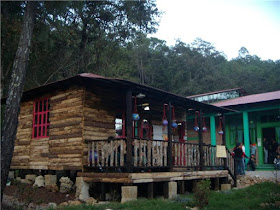
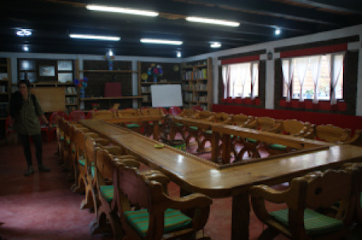
Lejos de tener carencias, la Universidad de la Tierra se muestra como un paraíso. Las instalaciones y su integración en la naturaleza distan mucho de lo que podemos pensar de esta universidad sin zapatos, como se autodenomina. Además de las decenas de talleres (entendidos como lugar físico), del comedor y de las construcciones que guardan los generadores; son varias las salas para seminarios y aulas que se prestan a otros movimientos sociales. Una colorida capilla se presta a la realización del culto y un enorme auditorio se abre a grandes celebraciones y tiene siempre las puertas abiertas al EZLN, quien celebró en dicho auditorio la Clausura del Primer Festival de las Resistencias y las Rebeldías Contra el Capitalismo este pasado mes de enero.
Filosofía e inspiración
Además de inspirarse en el EZLN y el obispo Samuel Ruiz, este centro por y para indígenas se asienta sobre los principios de Imanuel Wallerstein y de Iván Illich. Del primero agarran su análisis sobre el capitalismo basado en conceptos como Sistema – Mundo. Es de Iván Illich de quien beben sus concepciones acerca de la enseñanza, el aprendizaje y la desescolarización. Se olvidan del tipo de enseñanza impuesto por el capitalismo al que hacíamos referencia al comienzo de este texto y priman el aprendizaje en relación con las personas. Cómo diría Illich en La sociedad desescolarizada:
Los profesores de habilidades se hacen escasos por la creencia en el valor de los títulos. La certificación es una manera de manipular el mercado y es concebible sólo para una mente escolarizada. La mayoría de los profesores de artes y oficios son menos diestros, tiene menor inventiva y son menos comunicativos que los mejores artesanos y maestros.
La instrucción libre y rutinaria es una blasfemia subversiva para el educador ortodoxo. Ella desliga la adquisición de destrezas de la educación ‘humana’, que la escuela empaca conjuntamente, y fomenta así el aprendizaje sin título o permiso no menos que la enseñanza sin título para fines imprevisibles.
Dos citas muy prácticas para entender la filosofía del CIDECI que se basa en tres principios inquebrantables: “aprender haciendo”, “aprender a aprender” y “aprender a ser más”. Estos principios ejercen de guía principal a la vez que sirven de bola de demolición contra lo ya impuesto en materia de educación por el sistema actual. Una red entretejida por y para los indígenas de la mano del “Doc” Raymundo. “Seguir haciendo, seguir formando sin perder de vista las directrices del EZLN y de los pueblos originarios”. Porque la Universidad de la Tierra es por y para ellos.
Nous publions ci-dessous une lettre du collectif « Sauvons l’Université » adressée le 17 septembre 2020 aux députés et sénateurs français. Elle concerne le projet de « loi de programmation pluriannuelle de la recherche » (LLPR), récemment renommée « loi de programmation de recherche… » (LPR), ce qui ne change évidemment rien à son infâme contenu ! Fidèle à la stratégie du grignotage néolibéral poursuivie depuis maintenant plus de 40 ans (on profite d’une grande ou petite victoire pour lancer une nouvelle offensive voleuse, antisociale et irresponsable), cette loi vise à accélérer le démantelement du statut de la fonction publique dans l’enseignement supérieur et la recherche (ESR) – comme d’autres lois le font dans d’autres secteurs – et à aggraver, sous couvert d’« innovation », l’asservissement de l’ESR aux intérêts du capitalisme, multinationales en tête. Le savoir, y résister comme le font « Sauvons l’Université ! », « L’Internationale des savoirs pour tous » et tant d’autres collectifs dans l’ESR ou partout, c’est déjà préparer l’avenir, forcément révolutionnaire, d’une société postcapitaliste et postproductiviste.